Digital Deduction of Yang Qi
Ancients spoke of “gathering light to collect Qi”; moderns define light with lumens and color temperature. The essence has not changed, but the means are more precise. Through precise control of light's incident angle and layers, we reproduce the sun's energy field indoors. This is not lighting; this is the digital deduction of “Yang Qi.”
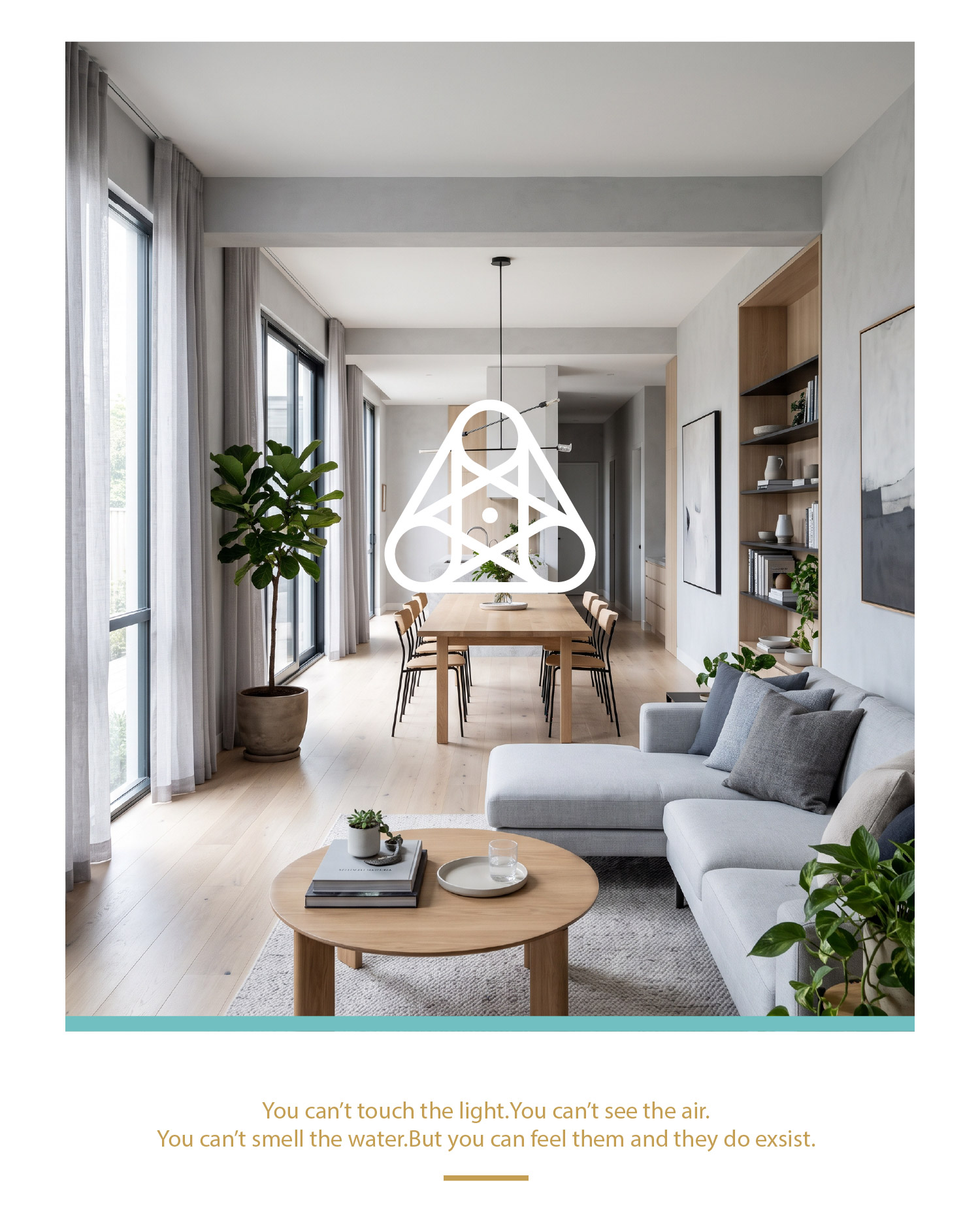
An apartment sold on its light, lit by one switch
Ancients spoke of “gathering light to collect Qi”; moderns define light with lumens and color temperature. The essence has not changed, but the means are more precise. Through precise control of light's incident angle and layers, we reproduce the sun's energy field indoors. This is not lighting; this is the digital deduction of “Yang Qi.”
Consider an apartment bought for its southern aspect. The windows run the length of the living room and the agent spoke about nothing else. Inside, the lighting is a grid of downlights on one circuit, specified for an even level across the whole floor plate.
A year later the curtains are closed most of the day, because the afternoon sun lands on the television and the sofa gets uncomfortably warm. In the evening the family switches on the grid, every surface receives the same cool light from the same direction, and the room they chose for its brightness is described by its owners as feeling flat. Nothing here is broken. The glass is excellent and the fixtures are good. The light was simply never designed as a set of decisions.
A single layer can only be on or off
Lighting that exists as one circuit has one setting that works and several that do not. It cannot be bright at the dining table and soft on the sofa, because those are the same decision. It cannot let the ceiling go dark while the walls stay lit. Every request from the occupants arrives as a demand to turn the whole room up or down.
What makes a room feel generous is not the quantity of light but where it comes from and what it falls on. A room lit only from above casts hard shadows on faces and leaves vertical surfaces dim, which reads as enclosure. The same room with light on its walls and ceiling feels larger at a lower total output.
The daylight side fails in the same way. A window with no shading control offers two states, glare or curtains, and occupants pick curtains because glare is intolerable and dimness is merely disappointing. The best light source in the building ends up switched off for most of the year.
A room becomes adjustable only when its light is divided into separate controllable layers, including the daylight coming through the glass.
What gathering light meant before lumens
The phrase in the seed text describes a practice, not a belief. Buildings were oriented so that main rooms received morning or afternoon sun according to their use. Courtyards bounced daylight into deep plans. Eaves were sized to admit low winter sun and exclude high summer sun. Screens and lattices broke direct light into something that could be lived with all day.
Each of those is a decision about incident angle, and each was made with no instrument other than observation and a long memory of how a site behaves through the year.
Reading Yang Qi as the sun’s presence in a room keeps the discussion on observable ground. The sun moves, its colour shifts from morning to evening, and a building either follows that movement or ignores it. The tradition chose to follow it with fixed geometry. A contemporary building can follow it with geometry and control together.
Four layers, each with its own decision
The living room above becomes workable once its light is separated into layers that can be set independently. None of this is exotic equipment; it is ordinary commissioning done with intent.
| Layer | What it does | How it is controlled |
|---|---|---|
| Daylight | The primary source, and the one that changes hourly | Blinds driven by sun position and measured daylight at the glass |
| Ambient | Light on walls and ceiling that sets the sense of volume | Separate DALI groups, dimmed rather than switched |
| Task | Enough light where work actually happens | Its own groups at the table, counter and desk |
| Accent | The contrast that stops a room reading as uniform | Low-output groups recalled by scene, not by switch |
Home Assistant holds the room, its luminaire groups, its blinds and the sun’s position in one entity model, so a scene can move all four layers together. As the sun crosses the façade, the blinds track the angle that keeps direct light off the seating while leaving the view, and the ambient layer dims as daylight rises rather than running at a fixed level beside a bright window.
Where the luminaires support colour temperature control through DALI, the evening scene can warm as the daylight does. Where they only dim, level alone still carries most of the effect, and that is worth saying plainly before a budget is committed.
Reproducing the sun is the one promise to avoid
The seed text speaks of reproducing the sun’s energy field indoors, and this is where the writing has to be careful. Daylight outdoors is orders of magnitude brighter than any interior installation, its spectrum is continuous in a way no lamp fully matches, and it arrives from the whole sky rather than from a fixture. A controlled installation can follow the sun’s rhythm and shape its light deliberately. It cannot stand in for it.
That is an argument for treating daylight as the main layer rather than a nuisance to be shaded out, and for spending the control budget on getting daylight into the room in a usable form before spending it on fixtures that imitate daylight.
The practical limits belong here too. Tunable fixtures cost more than fixed ones. Motorised blinds need power and a route for it. A room with sensors in the wrong place will dim at the wrong moment and be overridden within a week. Whatever is decided, the reasoning belongs in the O&M SOP handover so the next renovation does not quietly return the room to one circuit.
Who can ask how the light was actually used
Everything above is lighting design and control engineering. None of it requires AI, and a project should do it in the ordinary way long before anyone mentions a model.
What a language model changes is who can see the result. Every scene recall, every manual override and every blind movement is recorded in PostgreSQL through Supabase. Whether the layers are being used, or whether the household has settled back into one bright scene, is answerable from that history, and until now it was answerable only by someone willing to read logs.
With Pi Agent on Home Assistant, the owner or the designer can ask in a sentence, which matters most on the next project.
The answer is only as good as the sensors and the scene naming behind it, and a model can state a thin answer with confidence, so the underlying records should stay one step away. Within that limit, the oldest question in the tradition, whether a room is getting the light it was meant to get, becomes a question anyone can put to the building.
Where to go from here
Light shapes how a room feels. It also shapes when the people in it can sleep.
WELL 5.2 looks at lighting timed to the body clock, what the standard asks for, and what can honestly be claimed about it.
Feng Shui 5.1 of the Space Intelligence series on the Apporo blog.
Light · Air · Water · Control · apporo